


Encouraging AI adoption by EU SMEs
The EU should balance its desire to regulate the use of AI with the goal of facilitating its adoption by small businesses
BY Caleb Watney and Dirk Auer
Emerging Technology
Encouraging AI adoption by EU SMEs
The EU should balance its desire to regulate the use of AI with the goal of facilitating its adoption by small businesses
Emerging Technology
Introduction
For the firms that adopt them, artificial intelligence (AI) systems can offer revolutionary new products, increase productivity, raise wages, and expand consumer convenience. But there are open questions about how well the ecosystem of small and medium sized enterprises (SMEs) across Europe is prepared to adopt these new technologies. While AI systems offer some hope of narrowing the recent productivity gap between small and large firms, that can only happen if the technologies actually diffuse throughout the economy.
Policymakers have naturally been attracted to this topic as SMEs represent the backbone of the European economy, making up 99% of all businesses. 1 And an AI-enabled productivity boost would be particularly timely as SMEs are recovering from the effects of the ongoing Covid-19 crisis.
At the same time, the EU has articulated a desire to be on the forefront of developing novel AI regulations. The EU is contemplating new regulations on the development and deployment of AI that seek to address dual priorities: How can the EU simultaneously increase the uptake of AI by European firms while shaping the regulatory environment to protect European consumers from harm? 2
And while the EU’s ambition is laudable, the Commission’s pronouncements have so far failed to grapple meaningfully with the significant tradeoffs that the regulation of new technologies entails. As is the case with all new technologies, the adoption of AI systems — i.e., the broad suite of technologies that are designed to automate or augment aspects of human decision making — involves a tradeoff between risk-mitigation and rapid adoption. Unless carefully managed, the effort to protect consumers from potential risks places additional burdens on firms, which can chill investment and adoption, especially among SMEs. Policymakers thus need to achieve a balance between these two objectives.
With this in mind, our report outlines various policy considerations that should enable policymakers to achieve this balance between the two goals and embody the principle of Thinking Small First — the idea that public policy should consider the potential impacts on SMEs from the ground up. 3 The report discusses the promise for AI systems to increase productivity among EU SMEs, the current barriers to AI uptake, and policy tools that may be useful in managing the risks of AI while maximizing the benefits.
Dueling priorities
In February of 2020, the Commission published a white paper on artificial intelligence that recommended the adoption of new regulations to protect consumers and boost AI adoption: 4
The Commission supports a regulatory and investment oriented approach with the twin objective of promoting the uptake of AI and of addressing the risks associated with certain uses of this new technology.
These two goals stand somewhat in tension, as many policy outcomes often do. For instance, the Commission recites a litany of hypothetical harms AI might give rise to:
The use of AI can affect the values on which the EU is founded and lead to breaches of fundamental rights, including the rights to freedom of expression, freedom of assembly, human dignity, nondiscrimination based on sex, racial or ethnic origin, religion or belief, disability, age or sexual orientation, as applicable in certain domains, protection of personal data and private life, or the right to an effective judicial remedy and a fair trial, as well as consumer protection.
Citizens and legal entities will increasingly be subject to actions and decisions taken by or with the assistance of AI systems, which may sometimes be difficult to understand and to effectively challenge where necessary. Moreover, AI increases the possibilities to track and analyse the daily habits of people. […] AI is also used by online intermediaries to prioritise information for their users and to perform content moderation. [This] can affect the rights to free expression, personal data protection, privacy, and political freedoms.
Given the extremely broad harms that the Commission is targeting, and the fact that many of these sensitive industries are already heavily regulated, there are reasons to fear that ensuing regulation will be costly for European businesses.
In the Summer of 2020, the European Commission published a survey carried out by Ipsos on the uptake of AI tools by firms across Europe and the barriers those firms faced. 5 Overall they found that uptake has been relatively slow with only 3% of enterprises reporting using important tools like sentiment analysis and only 13% of firms using anomaly detection and process/equipment optimization. They also found that small firms have had a more difficult time adopting AI tools than large firms:
At the aggregate level, large businesses are more likely to be adopters compared to smaller businesses, which is to be expected based on data from other sources, such as the DESI, which suggests the same pattern. Larger companies have the potential to benefit most from the adoption of AI given their larger economies of scale and potential return on investment. Therefore, it is unsurprising to find that almost double the proportion of large enterprises (39%) use two or more AI technologies compared to microsized (21%) and small enterprises (22%).
The results of this survey should put into sharp relief the difficult task the EU faces. The EU should consider the tradeoff that exists between consumer protection and competition in the market. Indeed, regulation entails compliance costs that can, among other things, make it more difficult for SMEs to keep up with larger firms across Europe and around the world.
That’s not to say that AI regulation is per se unwarranted. Indeed, there are a host of malicious or unintentional harms that can occur from improperly calibrated AI systems. 6 Regulation can be a powerful tool to prevent these harms and, when well-balanced, can promote greater trust in the overall ecosystem. But there is already evidence that European SMEs face uncertainty regarding the actual regulatory obligations they need to meet to use AI systems. 7
Given this, we argue that the European approach to AI regulation would benefit from a recalibration. A well-functioning market economy generally requires a mix of property rights, liability rules, and regulations, and it is essential that the latter do not unintentionally hamper businesses and chill investment. We believe that, to the extent regulation is necessary, it should provide a framework for properly assessing risks and focus on actual, rather than merely hypothetical, consumer harm. This is particularly important in dynamic industries — like AI — where developing regulation is difficult because authorities are aiming at a moving target, and where policies need to nurture continued technological progress.
At the same time, there are a number of steps that the EU can take to proactively provide the underlying digital and data infrastructure that will make it easier for SMEs to take the leap in adopting AI tools. Much of this infrastructure operates as a type of public good that will likely be underprovided by the market without support from the EU and its member states.
Benefits of AI adoption
The central case for AI adoption is that human cognition is limited in a variety of ways, most notably in time and processing ability. Software tools can improve decision-making by increasing the speed and consistency with which decisions can be made.
AI tools are already being used across a wide range of domains to decrease power costs, improve logistics and sourcing systems, predict cash flows, steamline legal analysis, aid in drug discovery, improve factory safety conditions, and identify logistics efficiencies. 8
This is in addition to opening up entirely new fields like autonomous vehicles, drone delivery systems, and instantaneous language translation. 9
While many of AI’s most eye-catching use cases will likely remain the preserve of large platforms, the technology also holds tremendous promise for SMEs. Adoption of third party AI systems will notably enable SMEs to streamline mundane (but often costly) tasks such as marketing, customer relationship management, pre- and post-sales discussions with consumers, and SEO. 10 Along similar lines, research shows that AI-driven robotics have (and will continue) to boost productivity of SMEs in the manufacturing industry. 11
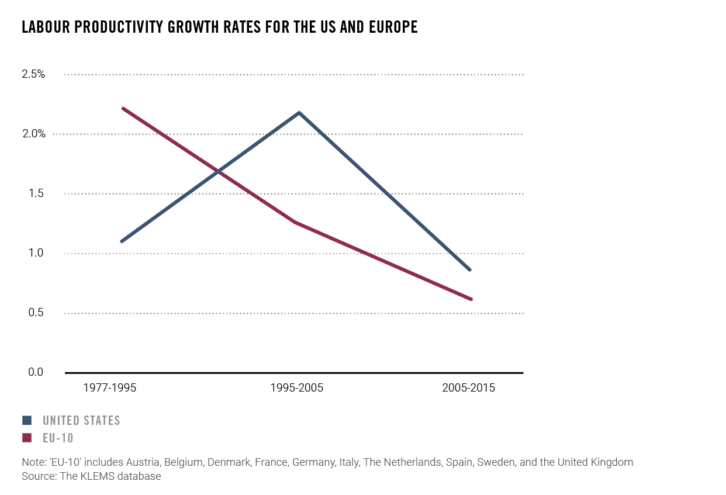
These changes can lead to significant gains in productivity that can potentially overcome the continued stagnant productivity growth in Europe when compared to the United States.
A paper by Robert J. Gordon and Hassan Sayed suggests that the surge in productivity between 1995 and 2005 that helped the US overtake the EU was primarily due to increased investment in and adoption of information and communications technologies. 12 Essentially, the U.S. made itself a natural home for the cutting edge of the digital economy and saw large productivity gains that the EU missed out on.
Although the causes of the EU’s relative decline are complex and a full analysis is beyond the scope of this paper, the EU should clearly be leery of falling further behind. To do so, it will need to harness the vast productivity gains that this next generation of AI technology will enable.
Importantly, this upcoming wave of AI technology can be especially impactful for SMEs and help them compete with larger, international firms because it can democratize the benefits of large information technology (IT) investments that superstar firms have been seeing over the last decade.
The economist James Bessen has argued that the top 5% of firms in many industries have been increasingly pulling away from the rest of the field because they have made large investments in proprietary IT systems. 13 Their smaller rivals struggle to develop their own systems because they lack the necessary scale to hire a large stable of in-house technical talent.

While AI tools can’t fully reverse this trend, they can help shrink the gap when embedded into Software as a Service platforms that smaller firms can make use of without the same level of investment. Essentially, through general-purpose AI tools, SMEs can have access to a host of productivity enhancements that these proprietary IT systems offer, but at a price point that is economical for SMEs. By shrinking this productivity gap, smaller firms can begin to compete in earnest while differentiating from large firms through improved customer service and more product diversity. This will give a large leg up to SMEs who adopt these AI systems and help them better compete with large global incumbent firms.
Consider a firm like Keelvar Systems, which uses advanced sourcing optimization and automation to help businesses rapidly shift supply chains around the globe in the event of disruptions or delays. 14 Essentially, it modernizes and scales the work that a large supply chain and sourcing office would do within a firm. By using their service, or others like it, SMEs have the ability to benefit from similar levels of sophistication in their supply chain management without having employees spend hundreds of hours on tedious tasks or maintaining expensive proprietary IT systems.
There are firms like Legal Robot that have created a series of tools to help small businesses have access to legal services that would otherwise require a small army of in-house lawyers. 15 With their service, SMEs can use smart contract templates based on their industry, receive instant contract analysis to make sure they are receiving fair terms, and can automate certain aspects of compliance with laws like the GDPR.
Likewise, companies like Bold360 have helped SMEs improve their customer service experiences by offering a variety of AI-powered-chatbots and tools. 16 Many basic customer concerns about products or delivery can be handled by these basic chatbots, freeing up human customer representatives to focus their time on the hard or advanced cases. Again, the pattern here is there is a service that large, multinational companies have been investing billions of dollars to create proprietary versions of and now the customizability of AI is helping this service become more accessible to SMEs.
What are the barriers to AI adoption for SMEs in the EU and what can policymakers do to help create a welcoming environment?
Data investment as a public good
Depending on the context, data can have the same traits as other public goods. First, it is non-rival — the marginal cost of producing a new copy of a piece of data is zero. Stated differently, multiple individuals can use the same dataset at almost no additional cost. The second important trait is that data is not difficult to appropriate. Think of this report. Once it has been posted online, it is difficult to prevent people from accessing and sharing it as they see fit. This is one of the reasons why copyright infringement is so hard to stamp out.
Oversimplifying, these two features can lead to two opposite problems. On the one hand, firms might underinvest in public goods, absent government-created appropriability mechanisms (such as patent and copyright protection). Conversely, public goods tend to be underutilized (at least from a static point of view). Any price that enables economic agents to recoup their investments in a public good will be above the good’s, “socially optimal”, marginal cost of zero. Public good policies thus involve a tradeoff between incentives to create and incentives to disseminate. For example, patents give inventors the exclusive right to make, use and sell their invention; but inventors must disclose their inventions, and these fall into the public domain after twenty years.
What does this mean for data and artificial intelligence? If policymakers think that data is an essential input for cutting-edge AI, then they should question whether obstacles currently prevent firms from investing in data generation or disseminating their data.
While all policies in this space involve significant tradeoffs, some offer much higher returns to social welfare. For instance, to the extent policymakers believe existing datasets are being underutilized, purchasing private entities’ data (through voluntary exchanges) and placing it in public data trusts would be a better policy than imposing data sharing obligations (which could undermine firms incentive to produce data in the first place). 17 This is akin to the idea of government patent buyouts. 18 Alternatively, policymakers could create regulatory safe harbors that facilitate the creation of private data trusts — and ensure that existing regulations, notably the GDPR, do not impede their creation. 19
Along similar lines, governments should ensure that existing regulations do not prevent data markets from emerging. For example, several provisions in the General Data Protection Regulation make it costly for firms to amass large datasets and outsource data processing (as opposed to conducting it in-house). 20 In other words, the regulation increases transaction costs and this might deter firms from specializing in data processing activities. Commenters like Sam Bowman from the International Center for Law & Economics have also argued that the GDPR prevents the emergence of markets for personal data by making the underlying rights inalienable. 21
Of particular interest for the EU, however, is the fact that their SMEs are sitting on top of data flows that are not being fully utilized because it’s expensive to make data usable and these datasets may not be very valuable in isolation. As an example, industry-level manufacturing data might be quite valuable to all firms, but the dataflows from one SME are much less valuable. The EU could align incentives by offering public investment funds so firms can quantify various aspects of business flows—provided this data is then submitted to public data trusts which would be accessible for use by all firms in the industry. This would essentially be treating industry dataflows as a type of public infrastructure that needs government investment to be fully realized. Depending on how it is constructed, this approach could be compatible with the idea of European data spaces as suggested in the EU data strategy. 22
This kind of public investment can happen not only through incentives for private firms but through the public sector as well. Governments at all levels (state, local, national, and supra-national) have valuable dataflows regarding infrastructure development, the organization of public transportation, and general macro-level economic data that can be turned into open datasets for public and commercial use. That the EU lags behind the U.S. and the UK in international open data rankings is a sign that more investment is needed. 23
Indeed, if key scientific or commercial datasets do not yet exist, the public sector may be best positioned to create them in the first place as a type of digital infrastructure provision. One notable structure that may help in this regard is the idea of a Focused Research Organization which would provide a team of researchers with an ambitious budget and a nimble organizational structure with the specific goal of creating new public datasets or toolkits over a set time period. 24
Provide regulatory certainty
European firms already have to contend with significant regulatory pressure. This includes the General Data Protection Regulation, the Regulation on Platform-to-Business relations, the e-Commerce Directive, as well as the upcoming Digital Services Act. This in addition to elaborate regulatory frameworks that operate in sensitive industries like healthcare, transportation, finance, insurance, etc. Ensuring compliance with the sheer scope and cross-cutting nature of these regulations is the source of significant legal uncertainty. In turn, this may reduce firms’ investments in new technologies, such as AI. 25
For instance, according to the Ipsos survey, “reducing uncertainty can be beneficial, as enterprises find liability for potential damages (33%), data standardisation (33%) and regulatory obstacles (29%) to be major external challenges to AI adoption”.
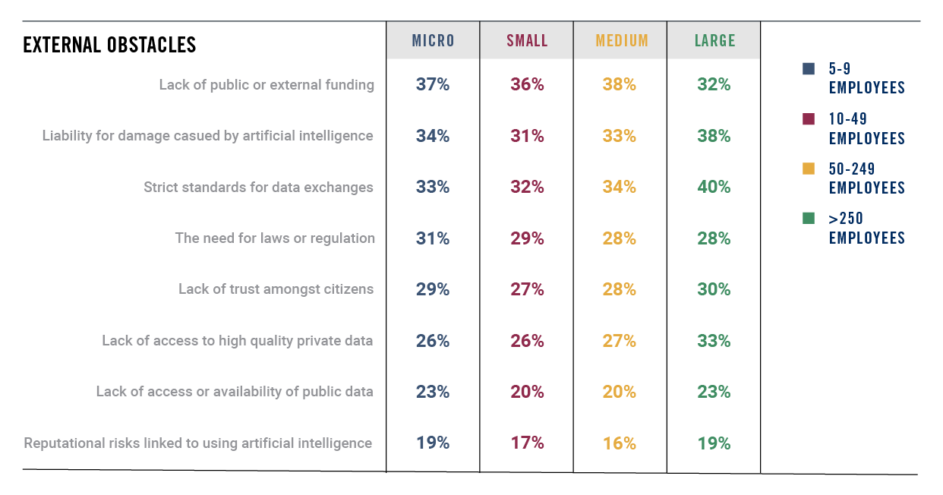
It is important that policymakers do not unnecessarily increase this already substantial regulatory burden. Regulations should be clear and targeted in order to promote investments and enable firms to experiment with new business ideas and technologies.
With that in mind, we offer the following recommendations.
For a start, it is generally preferable for policymakers to question whether existing regulations hamper the development and dissemination of AI systems, and whether they could evolve to resolve any outstanding issues. For example, to the extent that firms currently underinvest in data generation, tweaks or reinterpretations of the copyright and database directives would be preferable to new regulation. 26 With that in mind, the Commission is considering legislation that would reinforce the legal protection afforded to databases. 27 This may ultimately make it more profitable for firms to assemble novel datasets, as well as enable them to share these on the market (as opposed to merely using them in-house) while maintaining appropriate privacy safeguards.
Similarly, for many of the sensitive areas that policymakers most fear AI tools being abused, be they AI-assisted radiology diagnosis, autonomous vehicles, or financial loan offerings, there are industry-specific regulatory frameworks that already exist and may be a better avenue for addressing policy concerns. After all, in most cases it is the end result of a safe and reliable product or service that we care about rather than the technology used to achieve such a result. At the very least, the EU needs to be vigilant to ensure that new, sweeping regulatory action on AI tools by one part of the commission do not inadvertently contradict or overlap with the existing industry-specific regulatory frameworks.
Secondly, while we applaud the EU for its general embrace of a risk-based framework to regulation, we would encourage a more granular approach to differentiating high-risk to low-risk in the first place. 28 A few tangible considerations:
- Deciding entire industries are wholesale “high-risk” misses the fact that many AI applications within a high-risk industry may not, in fact, be high risk. Likewise, there may be the occasional high-risk use of AI within a generally low-risk industry. A framework based around use cases rather than industries may be more appropriate.
- The Commission should consider adding pathways for good actors within a high-risk industry to demonstrate a track record of safety and compliance and thereby be moved into a lower risk threshold.
- AI tools that operate on a business-to-business level should be considered lower risk than consumer facing tools given many of the problems typically associated with consumer risk (such as information asymmetries, decision fatigue, etc.) are much less likely with businesses.
Policymakers should also consider reforms to civil litigation procedure as an alternative to regulation. Regulation is often premised on the notion that liability rules alone are insufficient to deter harmful behavior. The Commission says as much in its white paper (“This in turn may make it difficult for persons having suffered harm to obtain compensation under the current EU and national liability legislation”). While such shortcomings could conceivably be addressed with new regulation, they can also be mitigated through simple reforms to existing liability regimes. Class actions are notoriously hard to bring in Europe. This is exacerbated by the fragmentation of Europe’s legal landscape. In that regard, the EU’s draft Collective Redress Directive marks a step in the right direction, as procedures of this kind enable consumers to outsource litigation to more sophisticated players. 29
More generally, policymakers should recognize that regulation is often more problematic for small firms that generally have less ability to shoulder compliance costs. Especially in industries with low marginal costs, such as the tech sector, larger firms can spread fixed compliance costs across more consumers, giving them a competitive edge over smaller rivals. Regulation can thus act as a powerful barrier to entry. For instance, a study found that the GDPR led to a 17% increase in industry concentration among technology vendors that provide support services to websites. 30
All of this is not to say that additional regulation is, or is not, necessary in the first place. Instead, our point is that potential regulation should follow sound policymaking principles that reduce the regulatory burden imposed on firms, notably by making regulation easy to understand and low-cost to comply with. Both the EU’s white paper on AI and its COVID-19 recovery plan foresee vast public investments in digital innovation, including AI. 31 These investments will be significantly less effective if chilling regulation prevents European firms from adopting the technologies in question.
Finally, EU policymakers should consider aggregating all this information through the creation of a dedicated SME AI regulatory website that provides a toolkit of resources about the benefits of AI adoption for their business, the potential obligations and roadblocks that they need to be aware of, and best practices for cybersecurity hygiene and data sharing.
Encourage an ecosystem of AI platforms
When deciding upon future AI policies, the European Union should consider the distinctive characteristics of its digital industry. Unlike the United States and China, the European Union has mostly been unable to foster global players in the digital platform industry. Of the 30 largest internet companies in the world by market capitalization, only one is European. 32 This does not mean that the EU has no tech industry, but rather that its tech industry is mostly made up of smaller players who have built their businesses upon larger platforms. As the EU itself has declared, SMEs are the backbone of its economy, making up 99% of all businesses. 33 We believe that the European Union should “lean in” to these features, rather than seek to duplicate the tech companies of other large nations. More specifically, European decision makers should recognize that tech startups share a symbiotic relationship with larger platforms. Regulations that overburden these platforms might thus hamper the European firms that depend on them.
[table id=4 /]
Policymakers should also recognize that developing in-house AI tools is far more difficult for SMEs than for large established firms. According to the Ipsos survey, only 28% of all EU enterprises develop these systems using in-house talent, and this figure skews disproportionately towards large firms rather than SMEs. 34 While building in-house AI tools has the benefit of greater customizability and integration designed for specific use cases, it is far more expensive and relies inherently on a certain level of scale to be economically viable. Realistically, this kind of bespoke in-house AI development will be out of reach for most SMEs.
However, as mentioned above, the benefits of AI can be accessible to SMEs through the use of external vendors and AI platforms. Many cloud computing platforms fill this role by providing out-of-the-box AI tools that can be applied by SMEs at a much lower cost and level of technical sophistication. Rather than build a tool from scratch, SMEs can use a general purpose AI tool and customize the parameters for their specific business. Sometimes this may require in-house technical expertise, but it is a much lower barrier to entry than building an entire AI development team. Already 59% of EU firms report purchasing software or ready-to-use systems and 38% hire external providers to develop AI applications, so this would be a continuation of a trend rather than a sharp break.
From a policy perspective, the EU needs to recognize that foreign AI platforms — mostly American — play a critical role in boosting AI adoption for European SMEs. 35 Protectionist tax and trade measures that hamstring AI platforms from other countries may end up backfiring on the European SMEs that most need their help. 36 Instead, the EU should encourage platforms of all types and from all around the world to conduct business in the EU so that SMEs can find the tools or services that best fit their business.
An additional and complementary approach would be for the EU to directly invest in a broad set of open-source AI platforms that could be utilized by SMEs. The EU AI White Paper recommended the creation of multiple cutting-edge AI centers that would be a good home for such a project. If these centers are well-funded they should be able to attract significant AI talent that could be tasked with creating open source platforms based on feedback from SMEs. This approach would pair well with the public data trusts suggested earlier and indeed they could benefit from one another.
It is also important to consider the cross-member state dimension of this ecosystem as well. One coordinating role the EU could play would be to convene experts from representative member-states at regular intervals and pull together a list of best practices for encouraging AI adoption among SMEs so that successful strategies can quickly be identified and adopted elsewhere.
Expand the AI talent pool
A lack of talent is one of the biggest barriers to AI adoption as the technical skills required to build or adapt AI models are in rare supply. According to the Ipsos survey, 57% of EU firms reported “difficulties in hiring new staff with the right skills” as a barrier to AI adoption. As noted above, SMEs may not need the same level of technical sophistication as large firms or AI platform companies, however, the insufficient talent pool remains a barrier.
In broad strokes, this skills shortage can be alleviated in two ways: through upskilling the domestic population and by improving immigration pathways for global talent.
According to a LinkedIn Economic Graph report, the EU employs half as many AI-skilled individuals as the U.S., despite a total labor force that is twice the size. 37 The EU risks falling behind in this regard. However, the same report finds that the EU has a comparatively large segment of their workers that possess “near AI-skills” which could allow the EU to significantly increase their talent pool in a short period of time with targeted upskilling.
Practically, the easiest way to do this would be to pay some portion of the costs of individuals and businesses who wish to upskill. If a small manufacturing firm has technically competent staff who wish to attend a specialized training course on using machine vision systems in a warehouse environment, it would be worthwhile for EU member states to incentivize this training financially. Not only would this benefit the firm and individual in question, but it would likely have knowledge spillovers for other workers in the firm. The EU should also be careful not to hinder the acquisition of European tech firms by foreign companies (as the draft Digital Markets Act threatens to do) because these mergers are an important source of international knowledge spillovers. 38
The EU should also look carefully at the immigration pathways for global talent seeking to start a business or work between multiple member states. International competition over the most talented AI researchers and practitioners has intensified in the past few years, and only seems likely to increase as the geopolitical benefits of leading in technology and science continue to increase. 39 While the immigration barriers for talented students are generally lower for the EU than for the U.S., there are still barriers to moving between member states that makes the EU less attractive for international tech talent. 40 As an earlier Politico article reported “For European tech companies, a visa that allows digital natives from India, China or the Middle East to enter the EU and move freely between countries is the ultimate dream.” 41
If the EU wished to be more proactive about recruiting international talent, they could explore the idea of creating an Office of Promigration which seeks to deliberately identify and recruit talented AI researchers and practitioners to the EU using a variety of incentives. 42
Using these two levers of upskilling and immigration reform, the EU should increase the supply of AI talent available to SMEs and thereby spur the adoption of AI adoption across Europe.
Conclusion
The EU has reached a fork in the road. The decisions it makes concerning the regulation of AI will significantly shape the European economy for decades to come. The EU will notably have to balance the tradeoffs between risk mitigation and the growth of its AI industry. In other words, it cannot have its cake and eat it — a fact that previous EU regulatory frameworks and the recent white paper struggle to recognize. Indeed, the white paper embodies both a maximalist vision of regulation and a hope that EU industry will prosper. With that in mind, this paper puts forward simple principles that would improve the Commission’s policies. This includes small changes to existing rules, reforms to Europe’s liability regimes, and targeted regulation where this proves necessary; policies that would enable European and foreign AI platforms to flourish; and policies to facilitate the emergence of a highly skilled technical workforce.
SUMMARY OF POLICY RECOMMENDATIONS
DATA INVESTMENT AS A PUBLIC GOOD
- Where appropriate, align incentives for the private sector to contribute industry-level SME data to public and private data trusts that could be used by everyone.
- Invest in making more government datasets open to the public.
- Fund Focused Research Organizations or similar groups with the explicit goal of creating new scientific and commercial public datasets.
PROVIDE REGULATORY CERTAINTY
- Clarify existing regulations and the obligations that SMEs must meet when utilizing a new AI tool.
- Consider the creation of a new SME regulatory website that provides informational resources to SMEs about the benefits of AI adoption for their business and the potential roadblocks that they need to be aware of.
- Before promulgating new regulations or regulatory bodies, closely scrutinize the ecosystem to see if the same goal could be better achieved through existing industry-specific regulations or fine adjustments to liability laws.
ENCOURAGE AN ECOSYSTEM OF AI PLATFORMS
- Avoid protectionist tax and trade policies that make it difficult for international AI platform companies to serve EU SMEs.
- Invest in the creation of open-source AI platforms that could be utilized by SMEs and create a forum for receiving feedback on the types of tools that would be most useful for SMEs.
- Articulate best practices on the member-state level for encouraging AI adoption so that the best ideas can be identified and quickly adopted elsewhere.
EXPAND THE AI TALENT POOL
- Encourage upskilling of the EU population by offering to cover a portion of the costs of specialized AI training courses.
- Reevaluate EU immigration pathways to make them more attractive for international technical talent.
- Facilitate global knowledge spillovers by removing potential obstacles to cross-border M&A.